
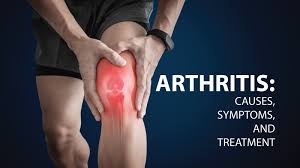
Arthritis
Arthritis is the swelling and tenderness of one or more of your joints. The main symptoms of
arthritis are joint pain and stiffness, which typically worsen with age. The most common types of
arthritis are osteoarthritis and rheumatoid arthritis.
Osteoarthritis causes cartilage the hard, slippery tissue that covers the ends of bones where they
form a joint to break down. Rheumatoid arthritis is a disease in which the immune system attacks
the joints, beginning with the lining of joints.
Uric acid crystals, which form when there’s too much uric acid in your blood, can cause gout.
Infections or underlying disease, such as psoriasis or lupus, can cause other types of arthritis.
Treatments vary depending on the type of arthritis. The main goals of arthritis treatments are to
reduce symptoms and improve quality of life.
Symptoms of Arthritis
The most common signs and symptoms of arthritis involve the joints. Depending on the type of
arthritis you have, your signs and symptoms may include:
- Pain
- Stiffness
- Swelling
- Redness
- Decreased range of motion
Causes of Arthritis
The two main types of arthritis osteoarthritis and rheumatoid arthritis damage joints in different
ways.
Osteoarthritis
The most common type of arthritis, osteoarthritis involves wear-and-tear damage to your joint’s
cartilage the hard, slick coating on the ends of bones where they form a joint. Cartilage cushions
the ends of the bones and allows nearly frictionless joint motion, but enough damage can result in
bone grinding directly on bone, which causes pain and restricted movement. This wear and tear can
occur over many years, or it can be hastened by a joint injury or infection.
Osteoarthritis also affects the entire joint. It causes changes in the bones and deterioration of
the connective tissues that attach muscle to bone and hold the joint together. It also causes
inflammation of the joint lining.
Rheumatoid arthritis
In rheumatoid arthritis, the body’s immune system attacks the lining of the joint capsule, a tough
membrane that encloses all the joint parts. This lining (synovial membrane) becomes inflamed and
swollen. The disease process can eventually destroy cartilage and bone within the joint.
Risk factors of Arthritis
Risk factors for arthritis include:
Family history. Some types of arthritis run in families, so you may be more likely to develop
arthritis if your parents or siblings have the disorder. Your genes can make you more susceptible
to environmental factors that may trigger arthritis.
Age
The risk of many types of arthritis including osteoarthritis, rheumatoid arthritis and gout
increases with age.
Your sex
Women are more likely than men to develop rheumatoid arthritis, while most of the people who have
gout, another type of arthritis, are men.
Previous joint injury
People who have injured a joint, perhaps while playing any sort of sport, are more likely to
eventually develop arthritis in that joint.
Obesity
Carrying excess pounds puts stress on joints, particularly your knees, hips and spine. People with
obesity have a higher risk of developing arthritis.
Complications of Arthritis
Severe arthritis, particularly if it affects your hands or arms, can make it difficult for you to
do daily tasks. Arthritis of weight-bearing joints can keep you from walking comfortably or sitting
up straight. In some cases, joints may become twisted and deformed.
Diagnosis of Arthritis
During the physical exam, your doctor will check your joints for swelling, redness and warmth. He
or she will also want to see how well you can move your joints.
Depending on the type of arthritis suspected, your doctor may suggest some of the following tests.
Laboratory tests
The analysis of different types of body fluids can help pinpoint the type of arthritis you may
have. Fluids commonly analyzed include blood, urine and joint fluid. To obtain a sample of your
joint fluid, your doctor will cleanse and numb the area before inserting a needle in your joint
space to withdraw some fluid.
Imaging
These types of tests can detect problems within your joint that may be causing your symptoms.
Examples include :
X-rays – Using low levels of radiation to visualize bone, X-rays can show cartilage loss, bone
damage and bone spurs. X-rays may not reveal early arthritic damage, but they are often used to
track progression of the disease.
Computerized tomography (CT) – CT scanners take X-rays from many different angles and combine the
information to create cross-sectional views of internal structures. CTs can visualize both bone and
the surrounding soft tissues.
Magnetic resonance imaging (MRI) – Combining radio waves with a strong magnetic field, MRI can
produce more-detailed cross-sectional images of soft tissues such as cartilage, tendons and
ligaments.
Ultrasound – This technology uses high-frequency sound waves to image soft tissues, cartilage and
fluid-containing structures near the joints (bursae). Ultrasound is also used to guide needle
placement for joint aspirations and injections.
Treatment of Arthritis
N.B – Arthritis treatment focuses on relieving symptoms and improving joint function. You may need
to try several different treatments, or combinations of treatments, before you determine what works
best for you.
Medications
The medications used to treat arthritis vary depending on the type of arthritis. Commonly used
arthritis medications include:
Painkillers
These medications help reduce pain, but have no effect on inflammation. An over-the-counter option
such as acetaminophen.
For more-severe pain, opioids might be prescribed, such as tramadol (Ultram, ConZip), oxycodone
(OxyContin, Roxicodone, others) or hydrocodone (Hysingla, Zohydro ER). Opioids act on the central
nervous system to relieve pain.
N.B – When opioids are used for a long time, they may become habit-forming, causing mental or
physical dependence.
Nonsteroidal anti-inflammatory drugs (NSAIDs)
NSAIDs reduce both pain and inflammation. Over-the-counter NSAIDs include ibuprofen (Advil, Motrin
IB, others) and naproxen (Aleve). Some types of NSAIDs are available only by prescription.
Oral NSAIDs can cause stomach irritation and may increase your risk of heart attack or stroke. Some
NSAIDs are also available as creams or gels, which can be rubbed on joints.
Counterirritants
Some varieties of creams and ointments contain menthol or capsaicin, the ingredient that makes hot
peppers spicy. Rubbing these preparations on the skin over your aching joint may interfere with the
transmission of pain signals from the joint itself.
Disease-modifying antirheumatic drugs (DMARDs)
Often used to treat rheumatoid arthritis, DMARDs slow or stop your immune system from attacking
your joints. Examples include methotrexate (Trexall, Rasuvo, others) and hydroxychloroquine
(Plaquenil).
Biologic response modifiers
Typically used in conjunction with DMARDs, biologic response modifiers are genetically engineered
drugs that target various protein molecules that are involved in the immune response.
There are many types of biologic response modifiers
Tumor necrosis factor (TNF) inhibitors are commonly prescribed. Examples include etanercept
(Enbrel, Erelzi, Eticovo) and infliximab (Remicade, Inflectra, others).
Other medications target other substances that play a role in inflammation, such as interleukin-1
(IL-1), interleukin-6 (IL-6), Janus kinase enzymes, and certain types of white blood cells known as
B cells and T cells.
Corticosteroids
This class of drugs, which includes prednisone (Prednisone Intensol, Rayos) and cortisone (Cortef),
reduces inflammation and suppresses the immune system. Corticosteroids can be taken orally or can
be injected directly into the painful joint.
Therapy
Physical therapy can be helpful for some types of arthritis. Exercises can improve range of motion
and strengthen the muscles surrounding joints. In some cases, splints or braces may be warranted.
Surgery
If conservative measures don’t help, your doctor may suggest surgery, such as:
Joint repair – In some instances, joint surfaces can be smoothed or realigned to reduce pain and
improve function. These types of procedures can often be performed arthroscopically through small
incisions over the joint.
Joint replacement – This procedure removes your damaged joint and replaces it with an artificial
one. Joints most commonly replaced are hips and knees.
Joint fusion – This procedure is more often used for smaller joints, such as those in the wrist,
ankle and fingers. It removes the ends of the two bones in the joint and then locks those ends
together until they heal into one rigid unit.
Lifestyle and home remedies
In many cases, arthritis symptoms can be reduced with the following measures :
Weight loss
If you’re obese, losing weight will reduce the stress on your weight-bearing joints. This may
increase your mobility and limit future joint injury.
Exercise
Regular exercise can help keep your joints flexible. Swimming and water aerobics may be good
choices because the buoyancy of the water reduces stress on weight-bearing joints.
Heat and cold
Heating pads or ice packs may help relieve arthritis pain.
Assistive devices
Using canes, shoe inserts, walkers, raised toilet seats and other assistive devices can help
protect your joints and improve your ability to perform daily tasks.
Visit us on : www.healthalert.co.za Calls us on : +27 82 0941 375
Email us on : info@healthalert.co.za